
Yang Style Tai Chi

Tai Chi Chuan is rooted in the ancient Chinese concept of Taiji – the Supreme Polarity – a constant interplay of Yin and Yang that gives rise to all movement, change, and life.
In Taoist philosophy, Taiji is the moment where the formless gives birth to form and where emptiness becomes the ten thousand things. Tai Chi practice mirrors this cosmology: each movement unfolds from stillness, returns to stillness, and reveals the energetic harmony that binds nature together.
Tai Chi’s metaphysical principles are reflected in its physical form, not only as a pathway to mental health, fitness, and longevity, but as a highly effective system of self-defence. Softness overcomes hardness, stillness creates movement, yielding leads to release, and effortless power rises from mental focus, alignment, and Qi control.
History of Yang Style Tai Chi
 Yang Luchan (1799-1872) was born in Yongnian County in north China’s Hebei Province. Because his family was very poor, he left home at the age of ten and travelled to Chenjiagou in Wenxian County, Henan Province, to earn a living. There he worked as an attendant in the Chen household, where he was accepted as a student of the renowned master Chen Changxing (1771–1853) and trained in the Lao Jia (Old Frame) system of Chen family Tai Chi.
After around thirty years of dedicated study and practice, Yang returned to Yongnian. Back home, he worked in the Tai He Tang medicine shop, which at the time was operated by members of the Chen family from Chenjiagou. The building belonged to the influential Wu family who became deeply impressed by Yang’s skill and encouraged him to teach them privately.
Before Yang Luchan, martial arts in the region were known mainly for strength, speed and direct force. Yang’s method – at first called “cotton boxing”, “soft boxing”, or “neutralising boxing” – astonished people with its ability to absorb, redirect, and overcome powerful attacks with seemingly effortless ease. His reputation grew quickly.
 A well-known story from this period concerns Wu Ruqing, who served as a councillor in the Sichuan office of the Imperial Judicial Department. He invited Yang Luchan to the capital, Beijing, to teach Tai Chi to nobles and members of the Imperial household.
Prince Duan, who kept many skilled fighters in his employ, wished to test the newcomer. Yang repeatedly declined formal challenges, but eventually one celebrated martial artist insisted on a friendly trial. They sat on two chairs facing one another and pressed their right fists together.

As the contest began, the challenger soon began to sweat and strain, and his chair creaked as though it might collapse, while Yang remained perfectly calm and composed. Standing up, Yang remarked to the onlookers, “This master’s skill is indeed superb. Only his chair is not made as firmly as mine.”
Yang Luchan became famous for being able to throw opponents to the ground without injuring them, earning the title “Yang the Invincible.” He was later appointed a martial arts instructor at the Qing court, one of the highest honours of the time.
 As Yang Luchan’s students grew in number, he and his eldest son Yang Shaohou (1862-1930) and third son Yang Jianhou revised the Chen Old Frame material into a Zhong Jia (Medium Frame) form. This was later refined by Yang Chengfu (1883-1936), Yang Jianhou’s third son, who developed the now-famous Da Jia (Big Frame) of modern Yang-style Tai Chi.
Yang Chengfu described Tai Chi as “an art in which great strength is concealed within softness, like an iron hand in a velvet glove, or a needle hidden in cotton.” He advised students to maintain roundness, relaxation and smoothness, allowing mind and body to move in harmony.
 One of Yang Chengfu’s students, Dong Yingjie, worked together on a fast frame, which remained unfinished at Yang’s death; Dong later completed it. This set includes faster, more explosive elements from Chen Old Frame, and learning it teaches practitioners how tai chi’s seemingly soft movements generate and express real martial power.
Tai Chi practice
Tai Chi is performed in a slow, relaxed, and deliberate manner. This cultivates balance, coordination and sensitivity, facia development, and Qi control, allowing practitioners to build an internal ‘quality’ that starts to manifest through correct practice.
Power in Tai Chi is “rooted in the feet, directed by the waist, and expressed through the hands”. As your movements become correct, coordinated, and alive with the right internal method, energy flows through the whole body, uniting it into an integrated network.
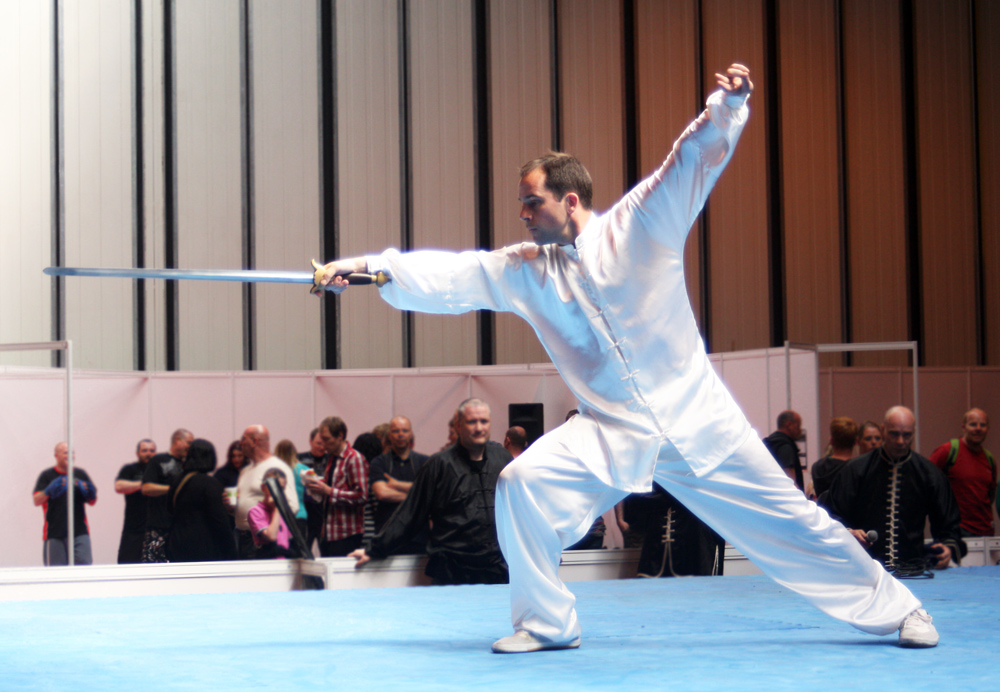 Rather than confronting force with force, it trains sensitivity, yielding and neutralisation to redirect an opponent’s strength and return it with added momentum, allowing “softness to overcome hardness”.
Even for those who practice Tai Chi purely for health, understanding the martial applications helps preserve the logic, precision and integrity of the movements. At the same time, Tai Chi is a profoundly personal journey of self-discovery.
The blend of relaxation and attentive concentration naturally promotes a meditative state, clearing the mind of everyday worries, such as work, money, and family, bringing your attention back into refining your own, personal quality. At higher levels, the refined control of internal energy (Qi) and a purity of spirit (Shen) that must be experienced to be fully understood.